As many of you know we got an invite to a semi-exclusive event with Obama. He was in Ghana for about twenty-four hours and in that time managed to stir up a mighty typhoon of a Obama frenzy. Everyone seemed to be talking about Obama, songs were written about Obama and played over and over on the radio (one chorus goes Barack Barack, Barack Obama - and that is pretty much the entire song. I think he must have thought Ghana a little crazy as they played this song wherever he went and everyone around him was wearing traditional looking african dresses made out of fabric with Obama's face all over it. We even enjoyed Obama cookies, the packages of which had the american flag and Obama on them (However, in my opinion, they did not taste quite Obamaee enough).
It was actually quite a big deal in for Ghana that he chose Ghana as the one country that he visited in Africa after Eqypt. It is a testament to Ghana's prosperity, peacefulness, and the growing strength of their democracy that he made this visit. He gave two speeches, one we saw at the airport and the other was at the parliament building. His speech to parliament was long and interesting and can be found on the internet. The speech we saw was much shorter but was meant for a specific audience of american development and embassy workers in Ghana. Obama thanked us Peace Corps volunteers a couple of times in his speech, which was very cool. He also visited the cape coast slave castle for a couple hours --- I guess Anderson Cooper did a special on this visit to the castle and also some expose on modern day slavery, I have yet to be able to check it out, but I imagine you all can find it on the internet.
So the event we went to was at the airport with air force one as the backdrop. Barack and the fam entered dramatically on big military helicopters. He was greeted by traditional music and dancing and then Ghana's president introduced Obama. He then gave a short speech praising Ghana for their commitment to democracy, talking about Peace Corps long history in Ghana and how he wants to continue the partnership etc. We were very close to him (about 30 feet away) where he spoke and then we were within a couple of feet when he shook hands with the crowd. Unfortunately we were a couple people back from the front and didn't get to shake his or michelle's hands. Some of our friends shook their hands and were thanked personally for their service.
The whole event was very cool, but super tiring. We travelled 14 hours to get down there and then of course needed to stay up most of the night reuniting with friends. The day of the event most of the major streets were shut down so we had to walk and walk and walk to get around. Then we had to wait for hours at the airport waiting for him to show up. But it was totally worth it.
Then K and I spent a night at a beach near Accra, you know since we were down there and all.
Saturday, July 18, 2009
Wednesday, July 8, 2009
Trees, Hippos, and Stars
We’ve now been in Ghana for over nine months and life seems somehow normal. Being stuffed inside dilapidated cars like clowns, carrying a bucket of water on my head, and brushing past a leg of cow while grocery shopping are all a part of my everyday existence here. We’ve had a few noteworthy events this past month so I’ll recount them.
Sherigu Environment Day 2009!!! On June 20th (the same day as my cousin’s wedding which I sadly missed) we held an event at our local school to raise environmental awareness. We worked with the primary school, the junior high school, and the two community-based organizations that brought us here to make it all happen. The Municipal Chief Executive, the Regional Directors of the EPA and the Ministry of Forestry, the Chief Fire Officer, and a moringa farmer were our guest speakers. The primary school put on a drama entitled “Tree is Life” which was really adorable. We held a poster contest and an essay contest for both schools and awarded someone the title “Environmentalist of the Year” for planting a lot of trees in the community. The headmaster at the primary school, Asoeh, has been an amazing person to work with these past few months. We worked with the students to nurse about 500 seedlings so far, and hope to nurse about 1000 more before the season is finished. The students will take them home and plant them. Using the internship program I worked with at the Mercer Slough as a model, my Environment Club at the Junior High went into all of the primary school classes and taught them a fun lesson about the need to preserve our natural resources and plant more trees. We had the Ministry of Forestry donate 500 seedlings for our event, some of which we planted at the school and the clinic, and others were given away as prizes. We had local groups sing and dance.
The event had a few glitches, like when the chairman didn’t show up and we started two hours late, but overall the event went well. We’ve really become quite the tree enthusiasts and it seems that maybe just maybe the enthusiasm is spreading through the community. We had some other volunteers come to stay with us for the event which was a lot of fun, especially when it started pouring while JJ and I were sleeping outside and the house leaked all over most everyone inside.
While trying to print certificates in Bolga I felt stress for the first time in a very long time, and as I went from copy center to copy center while my friends were all meeting for dinner, I realized how much I love my “job”. I honestly had not felt work stress since coming here. I never have to hear an alarm clock, I set my own schedule and activities for the day, I spend a lot of time outside, I work with really nice people, I have enough free time and enough to keep me occupied when I want to be productive. Life is good.
Having invested so much time and energy into this event, it seemed appropriate to take a vacation. Or friend Nicole came to our event and then convinced us to go back to her site in the Upper West with her. I was planning on going to Accra in a few days but we decided I could easily do that after visiting her. We stayed with Nicole for one night, and her accommodations made me realize how nice our house is. She was given one small room for sleeping, cooking, and living in, and she had a leaky roof with no ceiling, and a lot of biting ants. She’s an admirably positive and tolerant person and seems pretty happy despite her conditions.
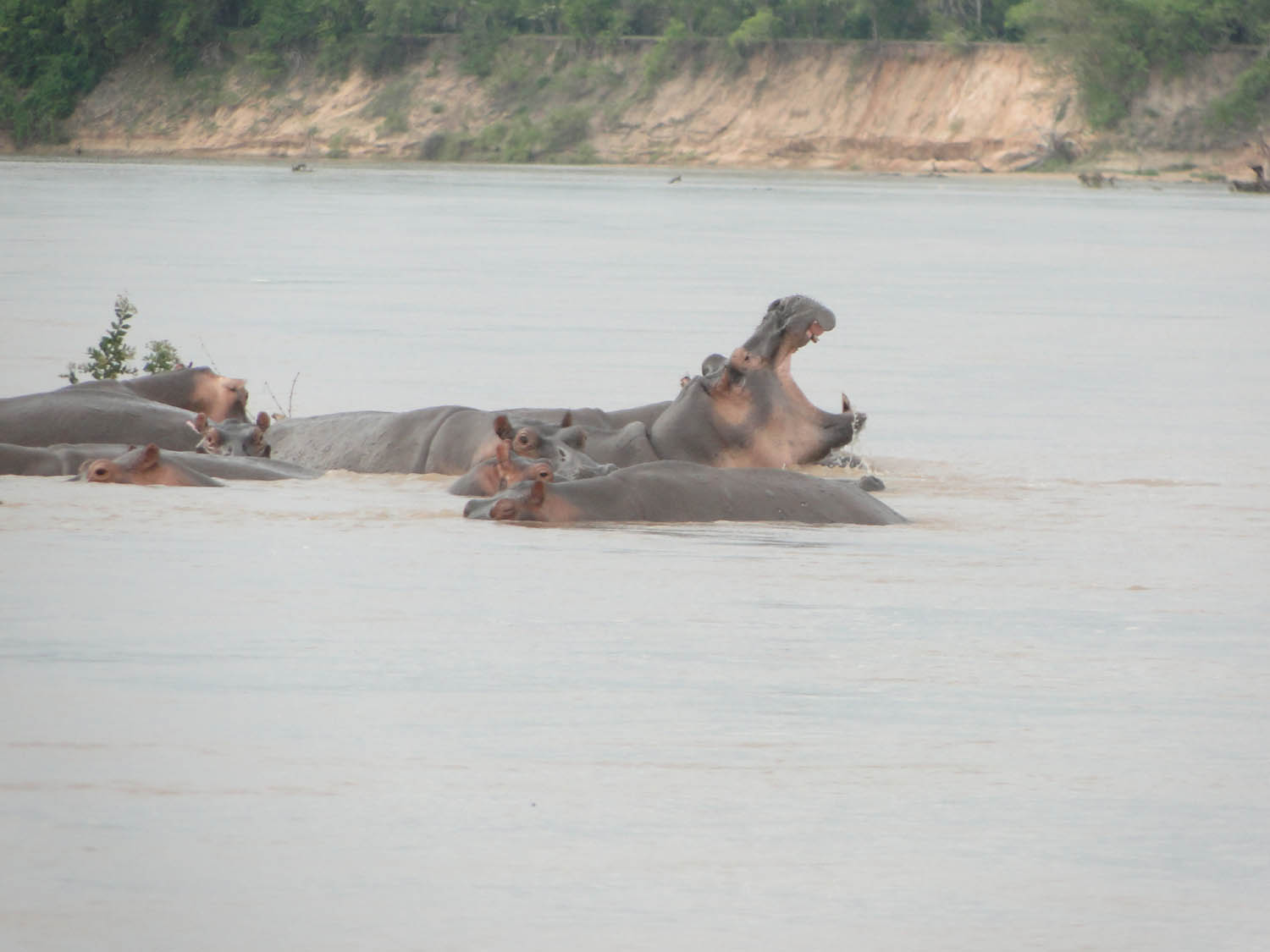
Another volunteer, Sinae, has a site 20km from the Wechiau Hippo Sanctuary. Many people in her community have never actually been to the sanctuary so she organized an event for a few schoolchildren and community members to run to the sanctuary and then take a boat tour and sleep at the guesthouse there. And that’s how we saw our first real live hippo in the wild. I know you’re all gaping right now at the idea of us running 20km. But alas, we have not changed that much since coming to Ghana and so we (and a bunch of other PCV’s and participants) biked it. The bike ride was beautiful. It seems greener and more savanna-like in the Upper West. The grass is always greener… The path was a bush path and at one point the ride got so bumpy we had to walk the bikes. The culprit? Hippo tracks. We also saw some monkeys off in the distance. The boat tour was pretty cool. We boarded a 6-person canoe and set off into the Black Volta River (which separates Ghana from Burkina Faso) in search of the elusive hippopotamus. Hippos are said to be the most dangerous animal in Africa, and the river is also home to crocodiles, snakes, and who knows how many microorganisms that want to make my insides do weird things, but we were ensured that this was a perfectly safe thing to do and that the hippos here are actually very friendly. They took us out for about 15 minutes or so and then we saw in the distance the head of a hippo! Apparently a lady hippo! We watched her disappear into the water and emerge a few times and then we headed back.
The next day we headed to Wa (the capital of the Upper West Region) and spent the day wandering and sitting and drinking and eating with some friends. We went to a fancy hotel restaurant where we ate Chinese and Indian food(!!!!) and then watched a soccer match that I hear was an important one between the US and Brazil. I’m trying to learn to like watching soccer. We’ll see how that goes…
The next day JJ headed back home and I began my 12-hour bus ride to Accra. The purpose of this ridiculously long voyage was to visit a planetarium. It’s the first planetarium to open in sub-Saharan Africa, and my PSC/Zoo friend Kyle told me about it and put me in touch with Jacob, the founder. He insisted that I come down for a visit to see if I could offer any assistance to their project. I’m pretty sure he tried to convince my Peace Corps supervisor to move my site to Accra to help him, but we compromised on a couple visits per year. After my 12-hour ride, Jacob insists on picking me up from the bus and taking me out to dinner at a fancy restaurant. For someone who makes about four dollars a day and has a hole in the ground for a toilet, this is very exciting. Jacob is a 73-year old Ghanaian who splits his time between London and Accra and is very passionate about science education. Over the next two days we ate pastries, pizza, mashed potatoes, and grouper, and brainstormed ways that I could maybe assist them on a small level. The planetarium is digital, so nothing like what I worked with at the Willard Smith Planetarium in Seattle, so I couldn’t really offer much assistance there, but they also have a portable planetarium, which I have worked with, so I’m going to develop some programs that they can take to schools. Jacob also wants a science center and some hands-on activities for kids to do, so I’m going to start a small science club in my community to test some activities out. He might be able to get me some telescopes for my community and we can start an astronomy club.
I left Accra and went and visited my friend Casimir in the Eastern Region. He took me on a grand tour that involved seeing an eco-friendly model home, a six-fingered palm tree (a botanical oddity), and a failed attempt to find a Deep Deep Well. The next day we went to the bead market in Koforidua which is always a dangerous place when you only make $4 a day, and then I went to my friend Lisa’s site, also in the Eastern Region. She made me some delicious homemade pizza and took me into a bamboo forest, a moringa farm, and a tiny snail farm! The next day we went to Kumasi and stayed at the Peace Corps sub-office.
There’s 67 new volunteers in training now and ten of them (the environment group) were heading to our site for a field trip, so I hitched a ride with them. It was great meeting the new volunteers, especially Ama, who will be moving relatively close to me in about a month and is therefore my new best friend. We spent the night of fourth of July at a drinking spot which was fun despite the appalling lack of fireworks or even a sparkler. The next day we took a surprise trip to Paga, home of the sacred crocodile pools. I got to sit on a 78 year old crocodile who, like the hippo, was very friendly. Then we went to our site where I was reunited with JJ, Kalulu, and the Moose (the cat’s name these days). We brought the trainees to the garden and showed them what we’ve been up to and we held a meeting with our supervisors and some of the women from our women’s groups. It’s nice having visitors.
So that’s been our excitement lately. Now its time to get back to work. We’re working on helping the school get a computer lab and resource center and next week we have someone from Trees for the Future coming to our site to do some agroforestry trainings for our groups. It seems like a really good organization to be working with, and our site was selected to receive seeds and tools and trainings from them. Hopefully we can keep the tree-planting craze that we’ve started alive.
Sherigu Environment Day 2009!!! On June 20th (the same day as my cousin’s wedding which I sadly missed) we held an event at our local school to raise environmental awareness. We worked with the primary school, the junior high school, and the two community-based organizations that brought us here to make it all happen. The Municipal Chief Executive, the Regional Directors of the EPA and the Ministry of Forestry, the Chief Fire Officer, and a moringa farmer were our guest speakers. The primary school put on a drama entitled “Tree is Life” which was really adorable. We held a poster contest and an essay contest for both schools and awarded someone the title “Environmentalist of the Year” for planting a lot of trees in the community. The headmaster at the primary school, Asoeh, has been an amazing person to work with these past few months. We worked with the students to nurse about 500 seedlings so far, and hope to nurse about 1000 more before the season is finished. The students will take them home and plant them. Using the internship program I worked with at the Mercer Slough as a model, my Environment Club at the Junior High went into all of the primary school classes and taught them a fun lesson about the need to preserve our natural resources and plant more trees. We had the Ministry of Forestry donate 500 seedlings for our event, some of which we planted at the school and the clinic, and others were given away as prizes. We had local groups sing and dance.
The event had a few glitches, like when the chairman didn’t show up and we started two hours late, but overall the event went well. We’ve really become quite the tree enthusiasts and it seems that maybe just maybe the enthusiasm is spreading through the community. We had some other volunteers come to stay with us for the event which was a lot of fun, especially when it started pouring while JJ and I were sleeping outside and the house leaked all over most everyone inside.
While trying to print certificates in Bolga I felt stress for the first time in a very long time, and as I went from copy center to copy center while my friends were all meeting for dinner, I realized how much I love my “job”. I honestly had not felt work stress since coming here. I never have to hear an alarm clock, I set my own schedule and activities for the day, I spend a lot of time outside, I work with really nice people, I have enough free time and enough to keep me occupied when I want to be productive. Life is good.
Having invested so much time and energy into this event, it seemed appropriate to take a vacation. Or friend Nicole came to our event and then convinced us to go back to her site in the Upper West with her. I was planning on going to Accra in a few days but we decided I could easily do that after visiting her. We stayed with Nicole for one night, and her accommodations made me realize how nice our house is. She was given one small room for sleeping, cooking, and living in, and she had a leaky roof with no ceiling, and a lot of biting ants. She’s an admirably positive and tolerant person and seems pretty happy despite her conditions.
Another volunteer, Sinae, has a site 20km from the Wechiau Hippo Sanctuary. Many people in her community have never actually been to the sanctuary so she organized an event for a few schoolchildren and community members to run to the sanctuary and then take a boat tour and sleep at the guesthouse there. And that’s how we saw our first real live hippo in the wild. I know you’re all gaping right now at the idea of us running 20km. But alas, we have not changed that much since coming to Ghana and so we (and a bunch of other PCV’s and participants) biked it. The bike ride was beautiful. It seems greener and more savanna-like in the Upper West. The grass is always greener… The path was a bush path and at one point the ride got so bumpy we had to walk the bikes. The culprit? Hippo tracks. We also saw some monkeys off in the distance. The boat tour was pretty cool. We boarded a 6-person canoe and set off into the Black Volta River (which separates Ghana from Burkina Faso) in search of the elusive hippopotamus. Hippos are said to be the most dangerous animal in Africa, and the river is also home to crocodiles, snakes, and who knows how many microorganisms that want to make my insides do weird things, but we were ensured that this was a perfectly safe thing to do and that the hippos here are actually very friendly. They took us out for about 15 minutes or so and then we saw in the distance the head of a hippo! Apparently a lady hippo! We watched her disappear into the water and emerge a few times and then we headed back.
The next day we headed to Wa (the capital of the Upper West Region) and spent the day wandering and sitting and drinking and eating with some friends. We went to a fancy hotel restaurant where we ate Chinese and Indian food(!!!!) and then watched a soccer match that I hear was an important one between the US and Brazil. I’m trying to learn to like watching soccer. We’ll see how that goes…
The next day JJ headed back home and I began my 12-hour bus ride to Accra. The purpose of this ridiculously long voyage was to visit a planetarium. It’s the first planetarium to open in sub-Saharan Africa, and my PSC/Zoo friend Kyle told me about it and put me in touch with Jacob, the founder. He insisted that I come down for a visit to see if I could offer any assistance to their project. I’m pretty sure he tried to convince my Peace Corps supervisor to move my site to Accra to help him, but we compromised on a couple visits per year. After my 12-hour ride, Jacob insists on picking me up from the bus and taking me out to dinner at a fancy restaurant. For someone who makes about four dollars a day and has a hole in the ground for a toilet, this is very exciting. Jacob is a 73-year old Ghanaian who splits his time between London and Accra and is very passionate about science education. Over the next two days we ate pastries, pizza, mashed potatoes, and grouper, and brainstormed ways that I could maybe assist them on a small level. The planetarium is digital, so nothing like what I worked with at the Willard Smith Planetarium in Seattle, so I couldn’t really offer much assistance there, but they also have a portable planetarium, which I have worked with, so I’m going to develop some programs that they can take to schools. Jacob also wants a science center and some hands-on activities for kids to do, so I’m going to start a small science club in my community to test some activities out. He might be able to get me some telescopes for my community and we can start an astronomy club.
I left Accra and went and visited my friend Casimir in the Eastern Region. He took me on a grand tour that involved seeing an eco-friendly model home, a six-fingered palm tree (a botanical oddity), and a failed attempt to find a Deep Deep Well. The next day we went to the bead market in Koforidua which is always a dangerous place when you only make $4 a day, and then I went to my friend Lisa’s site, also in the Eastern Region. She made me some delicious homemade pizza and took me into a bamboo forest, a moringa farm, and a tiny snail farm! The next day we went to Kumasi and stayed at the Peace Corps sub-office.
There’s 67 new volunteers in training now and ten of them (the environment group) were heading to our site for a field trip, so I hitched a ride with them. It was great meeting the new volunteers, especially Ama, who will be moving relatively close to me in about a month and is therefore my new best friend. We spent the night of fourth of July at a drinking spot which was fun despite the appalling lack of fireworks or even a sparkler. The next day we took a surprise trip to Paga, home of the sacred crocodile pools. I got to sit on a 78 year old crocodile who, like the hippo, was very friendly. Then we went to our site where I was reunited with JJ, Kalulu, and the Moose (the cat’s name these days). We brought the trainees to the garden and showed them what we’ve been up to and we held a meeting with our supervisors and some of the women from our women’s groups. It’s nice having visitors.
So that’s been our excitement lately. Now its time to get back to work. We’re working on helping the school get a computer lab and resource center and next week we have someone from Trees for the Future coming to our site to do some agroforestry trainings for our groups. It seems like a really good organization to be working with, and our site was selected to receive seeds and tools and trainings from them. Hopefully we can keep the tree-planting craze that we’ve started alive.

This is our wonderful wall that we spent a few months constructing. It bends around the side of the house and encloses a nice garden area. The cool looking grass wizard hat looking things is a house for our dog to hang out in when it rains. We began gardening in earnest a couple of weeks ago. We have planted about twenty tomato plants, many soy beans, peanuts, squash, sun flowers, and peppers. We plan to plant a bunch more in the next couple weeks.

God bless the rainy season and all the greenery that it has brough us. The landscape has really transformed over the past month. The tall crops that look like corn are actually millet (the staple food here). Kalulu, our super cute and awsome dog friend, is featured in this photo. She has taken to following us everywhere and protecting us by barking at strangers. The other day she followed me on a lengthy bike ride into the bush, comically ambushing unsuspecting goats and chickens all the way.
Friday, May 22, 2009
Funerals and the war dance
It’s funeral season here, in the Upper East region of Ghana. Everything seems to have its season in this part of the world, and they are all new to us. There’s rainy season, dry season, harmattan season (when cool winds blow on down from the Sahara and bathe us in their cool glory), sowing season (many different ones for different crops), growing season, harvesting season, festival season, a season for raising guinea fowls, mango season (a particularly delicious season), and on and on……
So funeral season is not a particular time of the year when everyone decides to drop dead, it’s actually a period of time during the dry season that everyone puts on their funerals. Burials and small ceremonies happen immediately after a death, but then you need to follow that up with a lavish, several daylong eating, drinking, dancing, singing, sacrificing – sleeping very little – and then drinking, dancing, dancing, drinking party. Some families need to save money for years before they can put on a proper funeral for their loved ones.
The people we live amongst just put on a funeral for a man who was the oldest community member. It was a fulneral-palooza lasting over a week, full of dancing, drinking, and soothsaying, you know – everything good in life. I collected music and pictures from the funeral and I interviewed a couple people about the rights and traditions of the funeral. So, what follows is that collection. You only have to read a little more before you can watch the slide show and listen to the music below.
After attending a couple of funerals I still don’t really know what’s going on fully. There are traditions o’ plenty, and unfortunately we are usually unable to communicate well enough with those around us to demystify the whole process. The most conspicuous part of the funeral is the war dance. People come from different communities and perform the old old traditions involved in the war dance you will see in the pictures below. They dress in animal skins, wear traditional helmets, carry bows and arrows and they go to war in the style of their ancestors. There are drummers, singers, and then the warriors and they dance in the style of warring, fighting. And I forgot to mention that most of these warriors had been drinking for a couple days at this point, serving to inject a large dose of mayhem into the scene. During and after the performance of the war dance the other people at the funeral join in, and the drumming and dancing will go on all night. They will light fires, roast goats, donkeys, and cows. They will shoot gun powder into the air and drink pito (local alcohol drink made from fermented millet – kind of tastes like beer). Hundreds of people come from all around to honor and to celebrate the life of the deceased. The funerals are kind of like weddings in the states (but with more animal sacrifice). We would wake up in the morning and the funeral faithful would still be awake, taking some morning drink.
The origins and meaning of the war dance were explained to me: Generations ago the people of this area were scattered into small tribes, and deaths during these days were more often a cause of a tribal conflict than natural causes. And after such a death the tribe would ready themselves for war and the act of retribution. As generations progressed tribes became more intertwined and with this twining peace laid its roots into the foundations of life. The war dance was an extension of that warring tradition, a way to honor the bravery of the deceased.
In the midst of all this celebration, there are many traditions and rights performed. We have caught glimpses of many of these, but they still remain a bit shrouded in mystery. We saw the widow of one man being enclosed in a small thatched area with various objects and her children. We were told that she needs to spend the night in this enclosure. At the funeral we just attended in our community we witnessed the part of the funeral ceremony when the family consults the soothsayer. A family member sits with the soothsayer surrounded by various ceremonial objects. The soothsayer holds a stick, fashioned from wood from a particular tree, and the family head holds the other end. The family asks questions concerning the death of the family member, and the questions are answered by the motion of the stick they are both holding. If the stick falls on a particular spot the answer is yes, if on another spot the answer is no, etc. Neither person is supposed to direct the motion of the stick, the movement is supposed to be a result of the spirits involved in the consultation. The soothsayer is mainly consulted to find out the cause of the person’s death, and to find out what precautions they should take to protect themselves from further suffering. The soothsayer will make recommendations about what animals should be sacrificed to ensure the strength and health of their family. An interesting part of the soothsayer consultation is the testing of the soothsayer. The family will test the soothsayer by taking a small object and placing it near a random tree, and the soothsayer will need to divine the tree. If the soothsayer fails at this they will know that he doesn’t speak the truth, apparently the soothsayer we saw picked the right tree. (How embarrassing would it be to pick the wrong tree?)
So I will let you get on to the slide show now. I have also included a small portion of an interview with a local fra fra man (fra fra = the name of the tribe in this part of Ghana). The man is talking about the soothsayer’s role in funerals and in general. It may be a bit hard to follow, but the info from above will give you an idea of what he is talking about. At the end of the interview is an audio recording of the soothsayer saying his soothe (the soothsayer shakes a rattle throughout the ceremony, supposedly it has the eyes of a bird called a kite in it to help the man see far….. Enjoy.
So funeral season is not a particular time of the year when everyone decides to drop dead, it’s actually a period of time during the dry season that everyone puts on their funerals. Burials and small ceremonies happen immediately after a death, but then you need to follow that up with a lavish, several daylong eating, drinking, dancing, singing, sacrificing – sleeping very little – and then drinking, dancing, dancing, drinking party. Some families need to save money for years before they can put on a proper funeral for their loved ones.
The people we live amongst just put on a funeral for a man who was the oldest community member. It was a fulneral-palooza lasting over a week, full of dancing, drinking, and soothsaying, you know – everything good in life. I collected music and pictures from the funeral and I interviewed a couple people about the rights and traditions of the funeral. So, what follows is that collection. You only have to read a little more before you can watch the slide show and listen to the music below.
After attending a couple of funerals I still don’t really know what’s going on fully. There are traditions o’ plenty, and unfortunately we are usually unable to communicate well enough with those around us to demystify the whole process. The most conspicuous part of the funeral is the war dance. People come from different communities and perform the old old traditions involved in the war dance you will see in the pictures below. They dress in animal skins, wear traditional helmets, carry bows and arrows and they go to war in the style of their ancestors. There are drummers, singers, and then the warriors and they dance in the style of warring, fighting. And I forgot to mention that most of these warriors had been drinking for a couple days at this point, serving to inject a large dose of mayhem into the scene. During and after the performance of the war dance the other people at the funeral join in, and the drumming and dancing will go on all night. They will light fires, roast goats, donkeys, and cows. They will shoot gun powder into the air and drink pito (local alcohol drink made from fermented millet – kind of tastes like beer). Hundreds of people come from all around to honor and to celebrate the life of the deceased. The funerals are kind of like weddings in the states (but with more animal sacrifice). We would wake up in the morning and the funeral faithful would still be awake, taking some morning drink.
The origins and meaning of the war dance were explained to me: Generations ago the people of this area were scattered into small tribes, and deaths during these days were more often a cause of a tribal conflict than natural causes. And after such a death the tribe would ready themselves for war and the act of retribution. As generations progressed tribes became more intertwined and with this twining peace laid its roots into the foundations of life. The war dance was an extension of that warring tradition, a way to honor the bravery of the deceased.
In the midst of all this celebration, there are many traditions and rights performed. We have caught glimpses of many of these, but they still remain a bit shrouded in mystery. We saw the widow of one man being enclosed in a small thatched area with various objects and her children. We were told that she needs to spend the night in this enclosure. At the funeral we just attended in our community we witnessed the part of the funeral ceremony when the family consults the soothsayer. A family member sits with the soothsayer surrounded by various ceremonial objects. The soothsayer holds a stick, fashioned from wood from a particular tree, and the family head holds the other end. The family asks questions concerning the death of the family member, and the questions are answered by the motion of the stick they are both holding. If the stick falls on a particular spot the answer is yes, if on another spot the answer is no, etc. Neither person is supposed to direct the motion of the stick, the movement is supposed to be a result of the spirits involved in the consultation. The soothsayer is mainly consulted to find out the cause of the person’s death, and to find out what precautions they should take to protect themselves from further suffering. The soothsayer will make recommendations about what animals should be sacrificed to ensure the strength and health of their family. An interesting part of the soothsayer consultation is the testing of the soothsayer. The family will test the soothsayer by taking a small object and placing it near a random tree, and the soothsayer will need to divine the tree. If the soothsayer fails at this they will know that he doesn’t speak the truth, apparently the soothsayer we saw picked the right tree. (How embarrassing would it be to pick the wrong tree?)
So I will let you get on to the slide show now. I have also included a small portion of an interview with a local fra fra man (fra fra = the name of the tribe in this part of Ghana). The man is talking about the soothsayer’s role in funerals and in general. It may be a bit hard to follow, but the info from above will give you an idea of what he is talking about. At the end of the interview is an audio recording of the soothsayer saying his soothe (the soothsayer shakes a rattle throughout the ceremony, supposedly it has the eyes of a bird called a kite in it to help the man see far….. Enjoy.
Monday, May 18, 2009
Wednesday, April 22, 2009

Kirsten and Kalulu! I picked up our new puppy from a friend when I was traveling down south. The dog was found abandoned in a pile of bricks and was in need of a home. The nine hour bus trip with her was not nearly as bad as one might imagine. Kalulu seems at home now and has even started barking at strangers that come over. She is extra cute when trying to play with the cat (who wants no part of her), and when she interacts with the goats and chickens that stop by. She is not so cute when attack our feet while we sleep.

Work party building our wall outside our house. Unfortunately the wall still isn't finished, but we are getting there. So this is the same process that most people use for building their houses and the same that built our house. You roll mud into balls and stack them up and mush them together (its actually really hard work and more complicated than that, but that's the general idea.) When its finished we can start work on a garden and get chicken to live in the chicken houses.

The beautiful beach at the green turtle lodge on the western coast of Ghana. It took a couple days of travel to get there from our desert home, but man was it worth it. After not seeing a body of water for months, swimming in that ocean was glorious. We played in the waves for days until we were thoroughly beaten down by the surf and our hearing began to suffer because of all the sand in our ears.

Kirsten looking all good at the hotel we stayed at near to cape coast and karkoum national park. The hotel was interesting, it looked like a place that was probably elegant and nice at some point in the distant past, but is now crumbling and a bit rundown, though still nice. It is built on stilts over a lagoon full of crocodiles. We were eating lunch and saw a guy touching one of the crocs, so we thought we would join him. A hotel employee ensured us that they were freindly crocodiles and that they dont like to eat people. So we touched its tale. And I totally recommend touching a croc to everyone the next time the opportunity presents itself. You get a sort of rush of adreneline being so close to a reptile with such a big mouth full of sharp teeth.

Karkoum national park canopy walk was super cool. Karkoum is the biggest rainforest preserve in Ghana, and unfortunately one of the few. Most forests in Ghana have been logged and over hunted. As a result you don't see a lot of wildlife around in general (except for lizards, ants, bats, spiders, scorpions - yay!) In the bush around where we live there are still many hunters who go into the bush with their bows and arrows, sling shots, clubs and kill monkeys, antelope, etc. As a result you dont really see monkeys or cool animals unless you go deep into the bush and are good at tracking animals - sad. Karkoum has a healthy population of cool animals (monkeys, forest elephants, antelope, etc) but unfortunately we did not see them.

A view of Cape Coast castle, on the coast of the town of Cape Coast. This castle was mostly built by the British in the early 1600s (although it was begun by Portuguese and taken over by dutch before British took it over and built most of it). It was mainly used as a store house and market for the slaves they were taking out of West Africa until the slave trade officially ended in Britain in 1807. Altogether some two million West Africans went through this one castle, over half of those died while in the castle or on route to their destinations. It was especially unnerving and emotional when the tour took us into the dungeons where the slaves were kept, conditions were unspeakably bad for them.

Cape coast is a big time fishing town, here are a group of fisherman doing their fisherman things. While Kirsten and I were staying on the beach we walked over to a small fishing village and came across a group of twenty or so men pulling a giant net out of the ocean from the shore. We joined them for about twenty minutes pulling and pulling and singing the work song they were singing. They must have been pulling that net in for over an hour. It was full of all kinds of fish and a couple of sea snakes, which one guy thought would be funny to take and thrown down at our feet.
Saturday, March 14, 2009
A little about what we do here
A little about what we do here. As for me, the male half of this dynamic partnership, I was hired on by the Peace Corps to be a health, water, and sanitation volunteer. This means that I am supposed to focus my projects and energies on bettering the health of this village through education, and community organization and mobilization. Many volunteers go into villages that have had volunteers working there for years and sometimes decades, some volunteers end up in villages that have ngos that use volunteers to assist in their projects. We are the first volunteers to be working in this village, and therefore we are starting from scratch. And starting from scratch is intimidating, it’s hard to know where to even begin. So that is basically where we’re beginning, trying to figure out where to begin.
Before I continue, a little more background about the general approach and mission of the Peace Corps. We are here for two major reasons: 1 --- For us American folk to learn about the Ghanaian folk, and for us to impart a little sumthin sumthin American (maybe deconstruct some stereotypes that fly both ways. Many people here think of America as a place where money falls in great monsoons each morning and Americans grow fat and happy splashing around in it. They think that there lives would be much better if they could visit America or live there. Through the relationships that we forge over here we hope to dispel myths we all carry around with us. 2 --- Give support in areas of development that the Ghanaian government and our village has deemed important to them. So we are here for two years to try and figure out what Ghanaians need to develop positively and sustainably, and help them work towards that.
So how do we do these things? Well we don’t know exactly, but I’ll tell ya what we are trying. Most importantly right now we are trying to get to know the village, build relationships and trust with people, and learn how to communicate with people. And to be honest all those things are a lot more difficult then you might think. To suddenly move into a village that people just don’t suddenly move into, a place where one stays in their family’s house of 80 some odd people that follow a generation that follows a generation of family that lived much like they do, farming the same crops, following most of the same traditions around marriage, death, celebration, and worship. To have a new person just move into this place that has been a world unto itself, is a bit jarring. So here we are. Well I should explain a bit more that this village has changed some in recent years, that it is not untouched by time. Electricity came here a few years back, although many to most still don’t have it. They live near a large town that has seen a lot of ngos come in and bring white folk talking about development. So many people here want development and they want better lives for themselves. Many are choosing to turn their backs on the traditional ways of religion and make new lives in Christianity (although the more you get to know this place you come to understand that traditional religion is so much a part of the culture and who these people are that adopting Christianity doesn’t just suddenly cancel out their beliefs that still surround them, their new beliefs seem to add a new layer to the foundation.) So here we are. We are like some kind of mystical creature from a fairy tale come to life. Most people knew about Americans, and have seen some white folk walking around the near by town, but most people here had never really met one. Many of the children’s first reaction to us was abject terror. Like we were ghost people come from a nightmare to terrorize them. And there are a few children who have been living around us for three months now who still quiver at the site of us. The adults aren’t frightened of us, just endlessly amused by us. Most everything we do is funny. The way we pronounce their language, the way we cook our food, the way we wash our clothes, the way we sweep, and on and on. So we step out of our house each day to be greeted by laughter, and an endless series of laborious conversations, where we try out new words that we have learnt that they often don’t understand, that are confusing and usually go nowhere. We sit with people while they are weaving baskets, breast feeding their children, preparing food, trying to figure out what they are saying and how to make ourselves understood in some way. And then the sun seems to get super angry with us and we dissolve into sweat, trying to muster up energy to cook our food, but then someone stops us asking us something that we don’t understand, does he want to know what we are cooking, where we are going, if he can have my wife, what happened to the ancient maya, who knows? --- So we are super hot, tired, confused, so far away from home. We enter our house to try and rest, but we hear our names being called outside and who’s that at the window? The children are watching us and trying to get our attention. The children can watch us for hours everyday. Watch us like the tv, like our lives our some broadway production come to town. But we are so tired and the children are there again and they will not respond to our pleas for solitude. Yikes. But we set about doing this each day and slowly we are getting know who people are, what they do, how we can maybe be of some assistance to them.
The ultimate aim is to develop partnerships with people in the village, to really understand what they want and need, and to figure out a realistic and sustainable way to help them get that thing. What we hoped to do is more about empowering people to help themselves than actually doing anything for them ourselves. The idea is that if given education and the knowledge about how to and where to find what they are after that they can do it for themselves. And that thing they did will be more meaningful to them and the benefits of that thing might inspire others to do things for themselves as well.
So on a day to day basis I go out into the scary world out there and try to get to know people and figure out what’s going on. I often go to the nearby health clinic and get to know the nurses, the mothers who attend the clinic with their babies, the problems that face the community. I sometimes have someone translate for me while I talk about malaria, HIV with people. I will interview mothers, asking them about their knowledge of health issues, what problems they face, what they want to improve in the community, etc. We also have put a lot of time into our house. When we got here it basically just had walls and a roof. Now we have furniture, linoleum on the floor, kitchen, painted walls, a courtyard area, ¾ of a wall built, electricity, and most exciting we are borrowing a freezer from a neighbor, so we will be able to have cold drinks and Kirsten will try and make ice cream (our quality of life just spiked big time). Also I just began an art club at the local school. Hopefully we will be painting murals, and doing some kind of musical dance performance for the community (but we have a long way to go).
Before I make this too long I will give this over to Kirsten to write a little something about Kirsten. Hopefully this wasn’t too scattered and gives a bit more insight into what we are doing.
Hi there! It’s me the lady part of the partnership! So I am an environment volunteer and my purpose in being here is to help the community ensure food security for future generations and to prevent the environmental degradation that would make food security impossible. My official title is Agroforestry and Alternative Livelihood Facilitator. Pretty exciting title huh? What does it mean, you ask? Agroforestry, generally speaking, is a sustainable method of farming that promotes the growing of trees in farms. Trees reduce soil erosion and flooding, create windbreaks, and many species will bring more yummy nitrogen into the soil. Not to mention the fact that they provide things like food (mmm…mangos…), fuelwood, fertilizer (the leaves of many species improve the soil), animal feed, medicine, shade (mmm….shade…), and building material. So I act as a tree enthusiast here in our village. The other half of my title involves working with small groups of people to develop alternative livelihood projects, or ALP’s. The major reason why people do not have enough food here is because they can’t afford it. So if they can make money by doing sustainable activities such as beekeeping, shea butter extraction, grasscutter rearing (rodent that people say is really tasty),or moringa or mango tree farming, then they will make enough money to feed their families.
About a month ago I started an environment club at the JSS. Although I kind of pride myself on having a lot of experience with leading groups of kids and teaching them, it’s a little bit more challenging when there’s 55 of them and they barely speak English and I barely speak Fra Fra and they are not used to things like inquiry-based teaching and playing games. It’s been fun and rewarding though. I gave them an assignment to bring in seeds for us to nurse and they brought in SO many different kids of seeds. We planted them and each of the kids is caring for a couple of them at their homes. JJ and I and the club are planning an Earth Day event right now, and we’ll plant the trees at the school, have a few contests (essay, poster, and garbage art), maybe have some kind of speaker, and have a dance party.
So what do I actually do here? I spend most of my working hours at a community garden where women from about 8 women’s groups are doing dry-season gardening (sweet potatoes, and two types of yummy greens that they use in soups) which means they have to carry all of the water for the garden on their heads. My role so far at the garden has been to simply help out where needed and by doing that I learn how gardens are done here, since I have no previous experience with gardening. I learned a few things in training, like how to make organic fertilizers and insecticides and I will be demonstrating how to do those. My other role at the garden is to motivate people to nurse and plant trees. We have so far nursed about 1500 seeds, and we will hopefully nurse about 1500 more. Sadly, about 500 of the saplings got eaten by chickens (another one of my duties at the garden is to make guttural noises at chickens and goats, and sometimes throw small rocks in their direction to make them go away).
So thus far we have been focusing mostly on integrating. In a couple weeks we'll both go to trainings where we will learn how to get grants for projects, so hopefully we'll be starting some bigger projects soon.
Before I continue, a little more background about the general approach and mission of the Peace Corps. We are here for two major reasons: 1 --- For us American folk to learn about the Ghanaian folk, and for us to impart a little sumthin sumthin American (maybe deconstruct some stereotypes that fly both ways. Many people here think of America as a place where money falls in great monsoons each morning and Americans grow fat and happy splashing around in it. They think that there lives would be much better if they could visit America or live there. Through the relationships that we forge over here we hope to dispel myths we all carry around with us. 2 --- Give support in areas of development that the Ghanaian government and our village has deemed important to them. So we are here for two years to try and figure out what Ghanaians need to develop positively and sustainably, and help them work towards that.
So how do we do these things? Well we don’t know exactly, but I’ll tell ya what we are trying. Most importantly right now we are trying to get to know the village, build relationships and trust with people, and learn how to communicate with people. And to be honest all those things are a lot more difficult then you might think. To suddenly move into a village that people just don’t suddenly move into, a place where one stays in their family’s house of 80 some odd people that follow a generation that follows a generation of family that lived much like they do, farming the same crops, following most of the same traditions around marriage, death, celebration, and worship. To have a new person just move into this place that has been a world unto itself, is a bit jarring. So here we are. Well I should explain a bit more that this village has changed some in recent years, that it is not untouched by time. Electricity came here a few years back, although many to most still don’t have it. They live near a large town that has seen a lot of ngos come in and bring white folk talking about development. So many people here want development and they want better lives for themselves. Many are choosing to turn their backs on the traditional ways of religion and make new lives in Christianity (although the more you get to know this place you come to understand that traditional religion is so much a part of the culture and who these people are that adopting Christianity doesn’t just suddenly cancel out their beliefs that still surround them, their new beliefs seem to add a new layer to the foundation.) So here we are. We are like some kind of mystical creature from a fairy tale come to life. Most people knew about Americans, and have seen some white folk walking around the near by town, but most people here had never really met one. Many of the children’s first reaction to us was abject terror. Like we were ghost people come from a nightmare to terrorize them. And there are a few children who have been living around us for three months now who still quiver at the site of us. The adults aren’t frightened of us, just endlessly amused by us. Most everything we do is funny. The way we pronounce their language, the way we cook our food, the way we wash our clothes, the way we sweep, and on and on. So we step out of our house each day to be greeted by laughter, and an endless series of laborious conversations, where we try out new words that we have learnt that they often don’t understand, that are confusing and usually go nowhere. We sit with people while they are weaving baskets, breast feeding their children, preparing food, trying to figure out what they are saying and how to make ourselves understood in some way. And then the sun seems to get super angry with us and we dissolve into sweat, trying to muster up energy to cook our food, but then someone stops us asking us something that we don’t understand, does he want to know what we are cooking, where we are going, if he can have my wife, what happened to the ancient maya, who knows? --- So we are super hot, tired, confused, so far away from home. We enter our house to try and rest, but we hear our names being called outside and who’s that at the window? The children are watching us and trying to get our attention. The children can watch us for hours everyday. Watch us like the tv, like our lives our some broadway production come to town. But we are so tired and the children are there again and they will not respond to our pleas for solitude. Yikes. But we set about doing this each day and slowly we are getting know who people are, what they do, how we can maybe be of some assistance to them.
The ultimate aim is to develop partnerships with people in the village, to really understand what they want and need, and to figure out a realistic and sustainable way to help them get that thing. What we hoped to do is more about empowering people to help themselves than actually doing anything for them ourselves. The idea is that if given education and the knowledge about how to and where to find what they are after that they can do it for themselves. And that thing they did will be more meaningful to them and the benefits of that thing might inspire others to do things for themselves as well.
So on a day to day basis I go out into the scary world out there and try to get to know people and figure out what’s going on. I often go to the nearby health clinic and get to know the nurses, the mothers who attend the clinic with their babies, the problems that face the community. I sometimes have someone translate for me while I talk about malaria, HIV with people. I will interview mothers, asking them about their knowledge of health issues, what problems they face, what they want to improve in the community, etc. We also have put a lot of time into our house. When we got here it basically just had walls and a roof. Now we have furniture, linoleum on the floor, kitchen, painted walls, a courtyard area, ¾ of a wall built, electricity, and most exciting we are borrowing a freezer from a neighbor, so we will be able to have cold drinks and Kirsten will try and make ice cream (our quality of life just spiked big time). Also I just began an art club at the local school. Hopefully we will be painting murals, and doing some kind of musical dance performance for the community (but we have a long way to go).
Before I make this too long I will give this over to Kirsten to write a little something about Kirsten. Hopefully this wasn’t too scattered and gives a bit more insight into what we are doing.
Hi there! It’s me the lady part of the partnership! So I am an environment volunteer and my purpose in being here is to help the community ensure food security for future generations and to prevent the environmental degradation that would make food security impossible. My official title is Agroforestry and Alternative Livelihood Facilitator. Pretty exciting title huh? What does it mean, you ask? Agroforestry, generally speaking, is a sustainable method of farming that promotes the growing of trees in farms. Trees reduce soil erosion and flooding, create windbreaks, and many species will bring more yummy nitrogen into the soil. Not to mention the fact that they provide things like food (mmm…mangos…), fuelwood, fertilizer (the leaves of many species improve the soil), animal feed, medicine, shade (mmm….shade…), and building material. So I act as a tree enthusiast here in our village. The other half of my title involves working with small groups of people to develop alternative livelihood projects, or ALP’s. The major reason why people do not have enough food here is because they can’t afford it. So if they can make money by doing sustainable activities such as beekeeping, shea butter extraction, grasscutter rearing (rodent that people say is really tasty),or moringa or mango tree farming, then they will make enough money to feed their families.
About a month ago I started an environment club at the JSS. Although I kind of pride myself on having a lot of experience with leading groups of kids and teaching them, it’s a little bit more challenging when there’s 55 of them and they barely speak English and I barely speak Fra Fra and they are not used to things like inquiry-based teaching and playing games. It’s been fun and rewarding though. I gave them an assignment to bring in seeds for us to nurse and they brought in SO many different kids of seeds. We planted them and each of the kids is caring for a couple of them at their homes. JJ and I and the club are planning an Earth Day event right now, and we’ll plant the trees at the school, have a few contests (essay, poster, and garbage art), maybe have some kind of speaker, and have a dance party.
So what do I actually do here? I spend most of my working hours at a community garden where women from about 8 women’s groups are doing dry-season gardening (sweet potatoes, and two types of yummy greens that they use in soups) which means they have to carry all of the water for the garden on their heads. My role so far at the garden has been to simply help out where needed and by doing that I learn how gardens are done here, since I have no previous experience with gardening. I learned a few things in training, like how to make organic fertilizers and insecticides and I will be demonstrating how to do those. My other role at the garden is to motivate people to nurse and plant trees. We have so far nursed about 1500 seeds, and we will hopefully nurse about 1500 more. Sadly, about 500 of the saplings got eaten by chickens (another one of my duties at the garden is to make guttural noises at chickens and goats, and sometimes throw small rocks in their direction to make them go away).
So thus far we have been focusing mostly on integrating. In a couple weeks we'll both go to trainings where we will learn how to get grants for projects, so hopefully we'll be starting some bigger projects soon.
Monday, February 23, 2009
For my 31st B-day Kirsten and I journeyed to a place called Tenzuk, not far from our site. The village and surrrounding area are sacred to many of the traditional believers in Ghana because of the ancient shrines tucked into caves in the surrounding hills. The area reminded me of Joshua Tree nat. park with the crazy looking rock formations, and had a sort of an ancient feeling to it with the homes of rounded mud formation and the prevelance of traditional religious practice. This is hyena cave that Kirsten is in. A Peace Corps volunteer was stationed at this village a few years back and she used to sleep in this cave. Longer ago Hyenas used to sleep here.Friday, February 20, 2009
This is the view from our house (looking straight out the front). That is a large compound house with 25 or more people in it. The tree is the tree that is used in religious ceremonies by our neighbors to give thanks to ancesterol spirits and offer them gifts. In the rainy season this burnt, barren ground will be all covered in millet stocks.
This is one of our super awesome neighbors. You can get an idea of the tribal scarring that people have on their faces and stomachs. The markings identify them as belonging to a certain tribe and people, and are given to them when they are very young. Some people's faces are covered in a spiderweb complexity of lines. People are moving away from marking their children these days. However, most children still get a couple of small scars on their faces and sometimes on their stomachs. These lesser scars are givento the children along with traditional medicine to protect them against certain diseases and dark spiritual forces. Tuesday, February 17, 2009
Interesting Things That Happen Here
- Most of you know that I've desperately wanted a cat for years now. The going rate for a kitten these days is one chicken and 10 pesewas (10 cents) so we went into Bolga on our bikes, bought a live chicken, strapped it to our bike and then rode back and exchanged it for our kitten. Tanga is an awesome kitty. When we first got her she was super-snuggly and sweet. Her favorite toy was a nail and her own tail, both of which she would chase around the house endlessly. We are struggling a little bit now because we go to a different house to sleep outside and so Tanga now lives there so we don't see her much during the day. She's growing up. She's got a cat friend who's been showing her the ropes. Once we get a wall built we'll bring her back home but for now she's happier over there. But I miss her a lot.
- I was doing laundry outside the other day when I looked over and saw two men on camels approaching us. We didn't share a common language but they gestured for me to get on the camel so what was I to do but climb up on the camel? So I sat on the camel. Camels are really tall! I gestured that I wanted the camel to walk around but instead they had me get down. Then JJ got on the camel and they let him ride it around.
- We live in a compound where about half the people are Christians and the other half are traditionalists (they practice the indigenous traditions). There is a tree in our front yard that is believed to house their ancestors and so there are often sacrifices performed there. Usually it's a chicken or a guinea fowl, but sometimes it's a goat or a sheep.
- Most people here have facial scars. Generally, the older they are the more elaborate the scarring. One person explained it to me as a tactic against being taken during the slave trade, and others say it is for tribal identification. It is actually against the law to do it today but many still do. Just about everyone (Christians, Muslims, and traditionalists) has a small scar on their cheek to ward off the ninga, which is a nocturnal bird. If a baby cries at the same time as the ninga the baby will fall ill, and so the scar offers the baby protection.
- The moon and the stars are awesome. We sleep under the stars (and our mosquito net) most nights because it's unbearably hot inside. It's been nice being so aware of the moon all of the time. When the moon is full you don't even need a flashlight top see your way around.
- I'm out of time here at the internet cafe. Once we get electricity the posts will become plenty.
Monday, January 5, 2009
Gold Mining
We have heard that there are gold mines near our site which are pretty dangerous. On our site visit a mother was mourning the loss of her son because the roof of the mine collapsed. The other day we visited a place where they grind up rocks and extract the gold. We were startled to see an adolescent put a drop of mercury on hand. The mercury attracts the gold like a magnet and then they use a blowtorch to burn away the mercury. I was curious about the health impacts of this and I discovered this article about bush mines in West Africa, which is exactly what is going on in our community. I would encourage you all to read it as it it pretty enlightening about where a lot of gold comes from.
http://www.usatoday.com/news/world/2008-08-10-104690609_x.htm
Our Journey Thus Far
Saturday, January 3, 2009
Our new address...
If anyone ever wants to send us anything our new address is:
Kirsten Tuhus and/or J.J. Gama-Lobo
PO Box 743
Bolgatanga, Ghana
West Africa
Kirsten Tuhus and/or J.J. Gama-Lobo
PO Box 743
Bolgatanga, Ghana
West Africa
Friday, January 2, 2009

Posing with part of our host family following our swearing in ceremony. For the ceremony each language group (our group of 40 volunteers were learning 10 different languages) had to do a small performance in the language. K and I greeted each other in fra fra to the tune of the indiana jones theme song, then we beatboxed as our friend did a fra fra rap. I'm sure we thoroughly embarassed ourselves.
Where to begin? A lot has changed for us in the past couple of weeks to say the least. We are officially Peace Corps Volunteers (rather than Trainees) and in addition to performing a Ghanaian dance and beat-boxing in Fra Fra (the language we're learning) at our swearing-in ceremony, we were each given a miniature plastic Gumby by our new country director. Gumby is apparently the patron saint of flexibility and we can call upon him in our more trying times, which is nice, as I imagine we'll have some trying times these coming years. Like biking in the middle of the day during the harmattan (this is great exercise!) or having diarrhea on Christmas Eve in a city with overflowing public latrines (at least there was a latrine!) or waiting four hours for a bus to come (perfect opportunity to work on that tricky crossword puzzle!).
It was pretty hard saying goodbye to all of our new friends. There are some truly awesome people out here and I really admire them. It's hard to imagine doing this without JJ. After swearing-in we took a little trip with some other volunteers to a monkey sanctuary. Before coming to Ghana I kind of had the impression (well, the hope) that there would be all kinds of African animals everywhere. I have seen a lot of cool birds (like sunbirds, whydah birds, hornbills, and weavers), lizards, Giant African Millipedes (my years at PSC have paid off), and two snakes, but I had been desperately searching the landscape for monkeys to no avail for several months. The monkey sanctuary thankfully satisfied this need for me. In most parts of Ghana, monkeys are killed and eaten and so they tend to stay as far away from people as possible. In this village, though, the monkeys are revered as ancestors by some and so there are a lot of happy monkeys. If a monkey dies in the village, they bury it in a special monkey cemetary. There are two kinds that live there--the mona and the black and white colobus. When I worked at the Woodland Park Zoo in Seattle, I would make regular visits to the black and white colobus monkeys there and they always looked so sad. It was really a rather profound experience for me to see this threatened species frolicking happily in the forest here in Ghana. As sad as it is to see animals in their enclosures in zoos, they really are ambassadors for their species and their lives are so important in making people care about their plight. JJ and I spent an extra day here and most if it was spent under a big monkey tree. We were eating bananas and a monkey emerges from the forest, walks right up to our bag of bananas, looks at us for a moment, then takes a banana out of the bag and proceeds to peel it and eat it! Monkeys really do like bananas I guess.
We then made our way up to our site. We were pleasantly surprised by the fact that the community had done some work on our house. They made us a little cement courtyard with a short wall that they will eventually build up more and will have a roof, which will be nice protection from the giant ball of fire in the sky. Right now we're in the "cold season" which means that it's only between, oh 10am-4pm that the sun is ridiculously hot. The nights are kind of cool I guess. We do need to sleep with a sheet over us. It's so funny to see Ghanains emerging from their homes in the morning--they are all bundled up in scarves and winter hats and jackets! I'm pretty terrified of March. I think it gets up to 115 degrees or so and even the nights are hot. Most people sleep outside because its cooler. Anyway, they also gave us some chairs, a mattress, put curtains up and sealed up most of the cracks in the floor. We are slowly but surely making it into a home--we've hired a carpenter to make us a wardrobe, some shelves, and a kitchen counter (currently our kitchen is on the floor). We painted our living room a nice shade of blue which helped a lot. Somehow the house seems bigger now than when we first saw it.
The lack of privacy is definitely something we're trying to get used to. Every now and then we look up at the window and see eyes staring back at us. Curtains are nice. For the first couple of days, and to some extent even still, every time we emerged from our house there would be children sitting in our courtyard. We would step out to do dishes or chop vegetables or just read. And they watch us like we are television. We are the most exciting thing to ever hit this village! What will we do next?! We are definitely lookng forward to getting a fence, which we claim is to keep the animals out so that we can plant a garden, but it will also be a nice way of getting a little more privacy.
I should mention that right now we are not at our site. We are actually in the Tamale sub-office (the TSO for short) because JJ wanted to be friends with a dog that turned out not to be a friendly dog. People actually like to eat dogs here and do not typically pet them or love them or even feed them regularly. So JJ got a small bite on his hand and since rabies exists here and is so very deadly he needed to get supplementary vaccinations. Normally this would be done in Accra but since we are still on lockdown because the election results are still not in we made the shorter journey to Tamale. We got here on New Years Day and will stay until Monday or possibly Tuesday. Which means four days of internet access, movies, running water, a kitchen, and privacy! And two shots for JJ, who is otherwise perfectly fine. Not rabid at all as far as I can tell!
The holidays were pretty weird. There are quite a few Christians that live here so they celebrate Christmas but it's definitely different. They do not have Christmas trees, for example. We felt that we needed a Christmas tree so JJ went and found us an ocra stalk that kind of resembled a Charlie Brown tree. We made ornaments out of paper and yarn and it turned out really nice. The Ghanaians thought JJ was pretty strange for taking a dead ocra stalk, but once we were able to communicate to them what we were doing with it they liked the tree and only thought we were a little strange. Cultural exchange! On Christmas morning we exchanged gifts--I got a machete (an essential farming tool), a beautiful basket woven by a women in our community, and some fabric that I will have made into a dress. JJ got a hat with the South Park characters on it, a necklace, and some fabric to have a shirt made. We then went to church. One of these days I will write a whole blog about church in Ghana because it is quite an experience. We went to the catholic church and it was actually kind of similar to Catholic church in America, in that there is a lot of sitting and standing and kneeling and recitations, but it lasts about three hours, none of it is in English, there is more dancing, and there is much more emphasis on giving offerings. Our commnuity is very poor, especially this year because of a bad harvest, so they could not eat chicken meat, which I guess is the customary thing to eat on Christmas, and the children did not receive any presents. Very different experience. And I had diarrhea for most of it as well. Needless to say, we were both feeling pretty homesick.
My 30th birthday on the other hand was fantastic. JJ presented me with a beautiful sculpture he made out of sicks and seed pods and brass bangles. He also made me oatmeal with apples in it for breakfast and spaghetti for lunch, both of which were very exciting believe it or not. There is a garden where I will be spending a lot of my time and I went there and planted some vetiver grass, which is used to prevent soil erosion and can also be used for weaving, as animal fodder, and as an essential oil used in the perfume industry (Haiti's a huge producer of this oil). Then we went for a long bike ride and had a nice picnic where we ate laughing cow cheese (the only cheese we get here) and cucumber sandwiches. I cannot express to you how happy the cucumber made me. Fresh, crunchy, watery things are absolutely amazing. We then went home and shared a box of wine and watched the Big Lebowsky on our laptop. Good times.
For New Years Eve we didn't do too much. In the middle of the day we went down to the social center (there's a tiny provisions store, a drinking spot, and people selling pito, the local beer made out of millet, and cosi the tasty fried bean patties) and each drank a callabash full of pito with a bunch of people that had been drinking a lot of pito already, which was a kind of overwhelming experience. We're slowly learning the language but it's tough. We both have decided we need to put a lot more effort into learning the language if we are going to be successful here. Later that night we rode our bikes to an area where we could lay and watch the stars. The stars are so incredibly amazing out here. We had kind of hoped to stay up until midnight but ended up passing out around 10 or so. I woke up in the middle of the night to use the latrine and I am so glad I did. I stepped outside and after noticing the ridiculous amount of sheep that make our yard their bed (which would explain all of the poop) I immedately saw the Southern Cross and Alpha Centauri! Until this point I hadn't really seen any new big southern hemisphere constellations. I then looked north and saw the Big Dipper, the Little Dipper, and the North Star, which I also hadn't seen in Ghana, and reminded me of home. as an ex-planetarian, this was a really great way for me to start the New Year.
I hope everyone is doing well and we wish you all the best for this coming year!
It was pretty hard saying goodbye to all of our new friends. There are some truly awesome people out here and I really admire them. It's hard to imagine doing this without JJ. After swearing-in we took a little trip with some other volunteers to a monkey sanctuary. Before coming to Ghana I kind of had the impression (well, the hope) that there would be all kinds of African animals everywhere. I have seen a lot of cool birds (like sunbirds, whydah birds, hornbills, and weavers), lizards, Giant African Millipedes (my years at PSC have paid off), and two snakes, but I had been desperately searching the landscape for monkeys to no avail for several months. The monkey sanctuary thankfully satisfied this need for me. In most parts of Ghana, monkeys are killed and eaten and so they tend to stay as far away from people as possible. In this village, though, the monkeys are revered as ancestors by some and so there are a lot of happy monkeys. If a monkey dies in the village, they bury it in a special monkey cemetary. There are two kinds that live there--the mona and the black and white colobus. When I worked at the Woodland Park Zoo in Seattle, I would make regular visits to the black and white colobus monkeys there and they always looked so sad. It was really a rather profound experience for me to see this threatened species frolicking happily in the forest here in Ghana. As sad as it is to see animals in their enclosures in zoos, they really are ambassadors for their species and their lives are so important in making people care about their plight. JJ and I spent an extra day here and most if it was spent under a big monkey tree. We were eating bananas and a monkey emerges from the forest, walks right up to our bag of bananas, looks at us for a moment, then takes a banana out of the bag and proceeds to peel it and eat it! Monkeys really do like bananas I guess.
We then made our way up to our site. We were pleasantly surprised by the fact that the community had done some work on our house. They made us a little cement courtyard with a short wall that they will eventually build up more and will have a roof, which will be nice protection from the giant ball of fire in the sky. Right now we're in the "cold season" which means that it's only between, oh 10am-4pm that the sun is ridiculously hot. The nights are kind of cool I guess. We do need to sleep with a sheet over us. It's so funny to see Ghanains emerging from their homes in the morning--they are all bundled up in scarves and winter hats and jackets! I'm pretty terrified of March. I think it gets up to 115 degrees or so and even the nights are hot. Most people sleep outside because its cooler. Anyway, they also gave us some chairs, a mattress, put curtains up and sealed up most of the cracks in the floor. We are slowly but surely making it into a home--we've hired a carpenter to make us a wardrobe, some shelves, and a kitchen counter (currently our kitchen is on the floor). We painted our living room a nice shade of blue which helped a lot. Somehow the house seems bigger now than when we first saw it.
The lack of privacy is definitely something we're trying to get used to. Every now and then we look up at the window and see eyes staring back at us. Curtains are nice. For the first couple of days, and to some extent even still, every time we emerged from our house there would be children sitting in our courtyard. We would step out to do dishes or chop vegetables or just read. And they watch us like we are television. We are the most exciting thing to ever hit this village! What will we do next?! We are definitely lookng forward to getting a fence, which we claim is to keep the animals out so that we can plant a garden, but it will also be a nice way of getting a little more privacy.
I should mention that right now we are not at our site. We are actually in the Tamale sub-office (the TSO for short) because JJ wanted to be friends with a dog that turned out not to be a friendly dog. People actually like to eat dogs here and do not typically pet them or love them or even feed them regularly. So JJ got a small bite on his hand and since rabies exists here and is so very deadly he needed to get supplementary vaccinations. Normally this would be done in Accra but since we are still on lockdown because the election results are still not in we made the shorter journey to Tamale. We got here on New Years Day and will stay until Monday or possibly Tuesday. Which means four days of internet access, movies, running water, a kitchen, and privacy! And two shots for JJ, who is otherwise perfectly fine. Not rabid at all as far as I can tell!
The holidays were pretty weird. There are quite a few Christians that live here so they celebrate Christmas but it's definitely different. They do not have Christmas trees, for example. We felt that we needed a Christmas tree so JJ went and found us an ocra stalk that kind of resembled a Charlie Brown tree. We made ornaments out of paper and yarn and it turned out really nice. The Ghanaians thought JJ was pretty strange for taking a dead ocra stalk, but once we were able to communicate to them what we were doing with it they liked the tree and only thought we were a little strange. Cultural exchange! On Christmas morning we exchanged gifts--I got a machete (an essential farming tool), a beautiful basket woven by a women in our community, and some fabric that I will have made into a dress. JJ got a hat with the South Park characters on it, a necklace, and some fabric to have a shirt made. We then went to church. One of these days I will write a whole blog about church in Ghana because it is quite an experience. We went to the catholic church and it was actually kind of similar to Catholic church in America, in that there is a lot of sitting and standing and kneeling and recitations, but it lasts about three hours, none of it is in English, there is more dancing, and there is much more emphasis on giving offerings. Our commnuity is very poor, especially this year because of a bad harvest, so they could not eat chicken meat, which I guess is the customary thing to eat on Christmas, and the children did not receive any presents. Very different experience. And I had diarrhea for most of it as well. Needless to say, we were both feeling pretty homesick.
My 30th birthday on the other hand was fantastic. JJ presented me with a beautiful sculpture he made out of sicks and seed pods and brass bangles. He also made me oatmeal with apples in it for breakfast and spaghetti for lunch, both of which were very exciting believe it or not. There is a garden where I will be spending a lot of my time and I went there and planted some vetiver grass, which is used to prevent soil erosion and can also be used for weaving, as animal fodder, and as an essential oil used in the perfume industry (Haiti's a huge producer of this oil). Then we went for a long bike ride and had a nice picnic where we ate laughing cow cheese (the only cheese we get here) and cucumber sandwiches. I cannot express to you how happy the cucumber made me. Fresh, crunchy, watery things are absolutely amazing. We then went home and shared a box of wine and watched the Big Lebowsky on our laptop. Good times.
For New Years Eve we didn't do too much. In the middle of the day we went down to the social center (there's a tiny provisions store, a drinking spot, and people selling pito, the local beer made out of millet, and cosi the tasty fried bean patties) and each drank a callabash full of pito with a bunch of people that had been drinking a lot of pito already, which was a kind of overwhelming experience. We're slowly learning the language but it's tough. We both have decided we need to put a lot more effort into learning the language if we are going to be successful here. Later that night we rode our bikes to an area where we could lay and watch the stars. The stars are so incredibly amazing out here. We had kind of hoped to stay up until midnight but ended up passing out around 10 or so. I woke up in the middle of the night to use the latrine and I am so glad I did. I stepped outside and after noticing the ridiculous amount of sheep that make our yard their bed (which would explain all of the poop) I immedately saw the Southern Cross and Alpha Centauri! Until this point I hadn't really seen any new big southern hemisphere constellations. I then looked north and saw the Big Dipper, the Little Dipper, and the North Star, which I also hadn't seen in Ghana, and reminded me of home. as an ex-planetarian, this was a really great way for me to start the New Year.
I hope everyone is doing well and we wish you all the best for this coming year!
Thursday, December 11, 2008
Election 2008 (The Ghanaian One)
So as some of you may know, Ghana just had a presidential election on December 7th. As we aren't supposed to get involved in the politics were, we spent the day in our quiet little training village of Addo Nkwanta. Our day involved going for a really nice walk on a bush path which took us out through a cocoa farm and a really awesome giant tree, playing some ping pong (that's right--ping pong!--and I actually beat JJ!--twice!), and watching some episodes of 30 Rock on someone's laptop.
There were several polling stations in the small village so there weren't really any lines or any big hoopla or anything. People vote by putting their thumbprint next to the picture of their candidate. When the results started coming in that evening a lot of people were gathered at the center of town listening to the radio blaring (the radios are typically blaring over here) and you could feel the excitement and anticipation. And it blared on for awhile but as it turns out the results didn't come in until yesterday (3 days later). And the winner is....no one yet! The candidate would have had to get 50% of the vote plus one in order to win, and since there were a few parties aside from the main two parties (NPP is the incumbant party and more similar to republicans and NDC leans more toward social democracy) and there was about 2% of the vote that were misvotes, neither candidate got the needed 50% plus 1. So there is now going to be a run-off on December 28th. We weren't sure what this would mean for us, since they had intentionally consolidated all of the volunteers for the Dec. 7th election and we are supposed to leave for our sites on the 13th. We found out today that we will be going to our sites and will be basically on lock-down from Christmas Eve until January 2nd, so we can't leave our sites at all during that time. The idea is that we are safest when we are at our sites and I'm confident that this is true, but it will be kind of a pain not to be able to go to the market at all in that time. I think we'll be eating lots of rice and beans for my 30th birthday and New Years! So though we might not be well fed for a few days, know that we are safe and should anything go wrong, the Peace Corps has a solid emergency action plan that will ensure our safety.
So as some of you may know, Ghana just had a presidential election on December 7th. As we aren't supposed to get involved in the politics were, we spent the day in our quiet little training village of Addo Nkwanta. Our day involved going for a really nice walk on a bush path which took us out through a cocoa farm and a really awesome giant tree, playing some ping pong (that's right--ping pong!--and I actually beat JJ!--twice!), and watching some episodes of 30 Rock on someone's laptop.
There were several polling stations in the small village so there weren't really any lines or any big hoopla or anything. People vote by putting their thumbprint next to the picture of their candidate. When the results started coming in that evening a lot of people were gathered at the center of town listening to the radio blaring (the radios are typically blaring over here) and you could feel the excitement and anticipation. And it blared on for awhile but as it turns out the results didn't come in until yesterday (3 days later). And the winner is....no one yet! The candidate would have had to get 50% of the vote plus one in order to win, and since there were a few parties aside from the main two parties (NPP is the incumbant party and more similar to republicans and NDC leans more toward social democracy) and there was about 2% of the vote that were misvotes, neither candidate got the needed 50% plus 1. So there is now going to be a run-off on December 28th. We weren't sure what this would mean for us, since they had intentionally consolidated all of the volunteers for the Dec. 7th election and we are supposed to leave for our sites on the 13th. We found out today that we will be going to our sites and will be basically on lock-down from Christmas Eve until January 2nd, so we can't leave our sites at all during that time. The idea is that we are safest when we are at our sites and I'm confident that this is true, but it will be kind of a pain not to be able to go to the market at all in that time. I think we'll be eating lots of rice and beans for my 30th birthday and New Years! So though we might not be well fed for a few days, know that we are safe and should anything go wrong, the Peace Corps has a solid emergency action plan that will ensure our safety.
Wednesday, December 10, 2008
Thursday, December 4, 2008
Monday, December 1, 2008
Kumblingo-Ayeobisi. Our new home
Kumblingo-Ayeobisi!
After quite literally years of anticipation, we finally know precisely where we will be serving in the Peace Corps. Accompanied by our two supervisors and two counterparts, we left the comforts of our training area and made the 17ish-hour journey up to our site in the Upper East region of the country. Most of it was pleasantly spent in the confines of an STC bus, which is equipped with both air conditioning (mmm…air conditioning…) and movies. I guess usually they are Nigerian movies, but we had an American movie which involved Val Kilmer battling lions, which was pretty entertaining.
We didn’t arrive at our site until about 11 at night, and the first thing we noticed was a large pedestal with a man atop it, sitting on a chair completely still, which seemed really bizarre until we realized it was a statue. This man for whom the statue was made had eight wives and his family (at least 40-50 people, one of which is our counterpart) lives in what we later learned as Molika Yire (the Red House). They built us a house in this compound and so Molika Yire is now our home!
I’ll take a few moments here to complain and then I’ll move on to all of the awesome things about our site. The first 12 hours or so in our new home were pretty rough. It began with me taking a bucket bath by candlelight in the bathing room. After a few minutes I turned around and was rather surprised to see that the walls were swarming with giant ants! The water had flooded out an ant hive and so they all came swarming out of the drain. Fortunately, they were not out for my blood and I didn’t get any bites, but it was not the friendliest welcome to our home for the next two years. Then it was time for bed. But there was no bed (or any furniture for that matter)—only one small sleeping mat and a rug. And it was really really hot in there because there isn’t really any cross-ventilation. But the 17 hour ride had really worn us out, so after ensuring that the mosquito net would keep the ants from devouring us in our sleep, we passed out. We were awakened a few hours later by footsteps outside our window. A radio began blaring and a man’s voice said “Hello? Hello?” The Ghanaian concept of both privacy and quiet hours are clearly a bit different than ours. We ignored this interruption and went back to sleep.
We awoke to the sounds we have grown accustomed to these past few months—roosters, goats, sheep, blaring radio, sweeping—and a few new ones—donkeys, cows, and people conversing loudly right next to our window. It was time to see our new home by the light of day. We have come to agree that this house could best be described as a fixer-upper, although technically it is a brand new house. With its small size and its mud plaster walls and floor and burglar-proof windows and complete lack of any furnishings whatsoever it feels well, kind of like a jail cell. We’ll be painting the walls (maybe a mural on one!) and putting some flashy linoleum down, and adding our own personal touches to turn it into a home. Our “yard” is dirt and dead crops and is visited by every domesticated animal known to this area and so is covered in animal feces! There’s also a nearby cesspool! Nothing a fence and a rocky drainage pit can’t solve, right? The other major issue is privacy, as we are right in the middle of Molika Yire and have no fence or curtains.
Okay. Whew! Now onto all of the awesome things. Our supervisor Sylvester is an amazingly motivated and inspirational human being. He does so many things to help his community that it took us the whole week we spent with him to get a decent grasp of all the things he does, and I imagine there’s more we don’t even know about. He was an orphan and so is working to help the orphans in the community. Apparently in this area if a child’s parents die, it is thought that the child is somehow evil and responsible for their deaths and so even though they’re usually taken in by relatives or friends they are not well taken care of and often are malnourished and uneducated. So Sylvester is hoping to start an orphanage where the kids don’t necessarily sleep there but will be fed and educated and cared for. Also, because of the lack of job opportunities in the area, there is a high prevalence of young, poor, and uneducated women moving down to Kumasi to be prostitutes. Sylvester is helping them become apprentices in trades like weaving and fabric dying, and would like to train some of them to be teachers for the orphanage. He has formed seven women’s groups in the area (he says that men are not as responsible or hard-working as women and so he only works with women) who are hoping to work together to generate some income through things like tree products (like cashews, mangoes, oranges, mahogany, and moringa), shea butter extraction, livestock rearing (they want me to help them start a piggery!) and beekeeping. His day job is as a security officer for the forestry commission, where he “protects the forest”. He talks at length about how much he loves trees.
My role in all of this will be primarily to help connect these groups that he has formed with government and non-government organizations who can help provide the money and the necessary training to these women’s groups so that they can improve their livelihoods. As far as the environmental aspect of all of this goes, by starting these alternative livelihood projects, fewer people will be prone to deplete the resources in the bush. I will also be helping the community plant lots and lots of trees, and I will also hopefully be promoting the use of organic fertilizers, compost heaps, and fuel-efficient stoves (that you make out of termite mound mud!). I’m also hoping to start an environment club at the junior high school here as well.
JJ’s role is a little less clear, but he will have no problem finding things to do here. As a health, water, and sanitation volunteer, his main goals are to help prevent diseases by educating people about how diseases are contracted and to help people maintain healthy diets. Seeing as our latrine might possibly be the only one in the community—people “free range” here, there are a lot of sanitation issues that he will be able to deal with. Watsan volunteers also do a lot of HIV/AIDS as well as family planning education.
The people in the community seem to be really nice and wonderful and they are definitely really glad to have us there. They seem to be really motivated to get to work and make some positive changes in their community. There was a ceremony for us which involved a lot of singing and dancing and drumming and speeches. These women—of all ages—are amazing dancers. I don’t think I can put into words how impressive their dancing is. I hope we manage to get some pictures up. We were told that our site was in a traditional area, and there are a lot of elements of this, like the music and the prevalence of facial scarring on just about everyone, including many children, but there are also a lot of Christians and a few Muslims. It was really nice to finally be in a place where Guruni is spoken all around us. We can’t say too much yet—mostly just greetings, food, and buying things—but hopefully the immersion will work some wonders on our abilities.
The area where we will be is really quite beautiful. Everything is really spread out and dry and relatively flat and this openness kind of reminds me a little bit of New Mexico and eastern Washington. My favorite part of this area is the baobab trees—they are huge and they are everywhere! I can easily imagine spending many hours under the shade of a baobab tree reading or drawing or playing the guitar. Parts of our community have electricity, but there really is hardly any light pollution so the stars are pretty amazing, though I think the dust of the harmattan season makes them a little muted.
We are about a thirty minute bike ride from Bolgatanga, which is great. We will be going there pretty frequently because our town doesn’t have much by way of food supplies. Thankfully there is a spot (the Ghanaian word for bar) about a mile from us, where we can get an ice cold Coke or Fanta or beer when the need arises. We can also get cosi, which is kind of like a nutritious doughnut (it’s basically beans ground up and fried-really tasty), whenever we want. There is a gigantic market in Bolga every three days, which incidentally is also the only time that cars go to and from our community. I really like that we can be so close to the comforts of a big town (we can get pretty much anything we need in Bolga) and still feel pretty isolated from the rest of the world when we are in our community.
We have another week and a half of training. We have a swearing in ceremony on December 12th, where we will perform a Ghanaian dance, and we should be at our site by the 14th or so. Training has really been a lot of fun. It’s a little like summer camp or freshman year of college in that we spend a lot of time with a small group of people and a lot of silliness ensues. It’s going to be a pretty major adjustment to not be surrounded by Americans all the time once we are at site, but we’re looking forward to it.
After quite literally years of anticipation, we finally know precisely where we will be serving in the Peace Corps. Accompanied by our two supervisors and two counterparts, we left the comforts of our training area and made the 17ish-hour journey up to our site in the Upper East region of the country. Most of it was pleasantly spent in the confines of an STC bus, which is equipped with both air conditioning (mmm…air conditioning…) and movies. I guess usually they are Nigerian movies, but we had an American movie which involved Val Kilmer battling lions, which was pretty entertaining.
We didn’t arrive at our site until about 11 at night, and the first thing we noticed was a large pedestal with a man atop it, sitting on a chair completely still, which seemed really bizarre until we realized it was a statue. This man for whom the statue was made had eight wives and his family (at least 40-50 people, one of which is our counterpart) lives in what we later learned as Molika Yire (the Red House). They built us a house in this compound and so Molika Yire is now our home!
I’ll take a few moments here to complain and then I’ll move on to all of the awesome things about our site. The first 12 hours or so in our new home were pretty rough. It began with me taking a bucket bath by candlelight in the bathing room. After a few minutes I turned around and was rather surprised to see that the walls were swarming with giant ants! The water had flooded out an ant hive and so they all came swarming out of the drain. Fortunately, they were not out for my blood and I didn’t get any bites, but it was not the friendliest welcome to our home for the next two years. Then it was time for bed. But there was no bed (or any furniture for that matter)—only one small sleeping mat and a rug. And it was really really hot in there because there isn’t really any cross-ventilation. But the 17 hour ride had really worn us out, so after ensuring that the mosquito net would keep the ants from devouring us in our sleep, we passed out. We were awakened a few hours later by footsteps outside our window. A radio began blaring and a man’s voice said “Hello? Hello?” The Ghanaian concept of both privacy and quiet hours are clearly a bit different than ours. We ignored this interruption and went back to sleep.
We awoke to the sounds we have grown accustomed to these past few months—roosters, goats, sheep, blaring radio, sweeping—and a few new ones—donkeys, cows, and people conversing loudly right next to our window. It was time to see our new home by the light of day. We have come to agree that this house could best be described as a fixer-upper, although technically it is a brand new house. With its small size and its mud plaster walls and floor and burglar-proof windows and complete lack of any furnishings whatsoever it feels well, kind of like a jail cell. We’ll be painting the walls (maybe a mural on one!) and putting some flashy linoleum down, and adding our own personal touches to turn it into a home. Our “yard” is dirt and dead crops and is visited by every domesticated animal known to this area and so is covered in animal feces! There’s also a nearby cesspool! Nothing a fence and a rocky drainage pit can’t solve, right? The other major issue is privacy, as we are right in the middle of Molika Yire and have no fence or curtains.
Okay. Whew! Now onto all of the awesome things. Our supervisor Sylvester is an amazingly motivated and inspirational human being. He does so many things to help his community that it took us the whole week we spent with him to get a decent grasp of all the things he does, and I imagine there’s more we don’t even know about. He was an orphan and so is working to help the orphans in the community. Apparently in this area if a child’s parents die, it is thought that the child is somehow evil and responsible for their deaths and so even though they’re usually taken in by relatives or friends they are not well taken care of and often are malnourished and uneducated. So Sylvester is hoping to start an orphanage where the kids don’t necessarily sleep there but will be fed and educated and cared for. Also, because of the lack of job opportunities in the area, there is a high prevalence of young, poor, and uneducated women moving down to Kumasi to be prostitutes. Sylvester is helping them become apprentices in trades like weaving and fabric dying, and would like to train some of them to be teachers for the orphanage. He has formed seven women’s groups in the area (he says that men are not as responsible or hard-working as women and so he only works with women) who are hoping to work together to generate some income through things like tree products (like cashews, mangoes, oranges, mahogany, and moringa), shea butter extraction, livestock rearing (they want me to help them start a piggery!) and beekeeping. His day job is as a security officer for the forestry commission, where he “protects the forest”. He talks at length about how much he loves trees.
My role in all of this will be primarily to help connect these groups that he has formed with government and non-government organizations who can help provide the money and the necessary training to these women’s groups so that they can improve their livelihoods. As far as the environmental aspect of all of this goes, by starting these alternative livelihood projects, fewer people will be prone to deplete the resources in the bush. I will also be helping the community plant lots and lots of trees, and I will also hopefully be promoting the use of organic fertilizers, compost heaps, and fuel-efficient stoves (that you make out of termite mound mud!). I’m also hoping to start an environment club at the junior high school here as well.
JJ’s role is a little less clear, but he will have no problem finding things to do here. As a health, water, and sanitation volunteer, his main goals are to help prevent diseases by educating people about how diseases are contracted and to help people maintain healthy diets. Seeing as our latrine might possibly be the only one in the community—people “free range” here, there are a lot of sanitation issues that he will be able to deal with. Watsan volunteers also do a lot of HIV/AIDS as well as family planning education.
The people in the community seem to be really nice and wonderful and they are definitely really glad to have us there. They seem to be really motivated to get to work and make some positive changes in their community. There was a ceremony for us which involved a lot of singing and dancing and drumming and speeches. These women—of all ages—are amazing dancers. I don’t think I can put into words how impressive their dancing is. I hope we manage to get some pictures up. We were told that our site was in a traditional area, and there are a lot of elements of this, like the music and the prevalence of facial scarring on just about everyone, including many children, but there are also a lot of Christians and a few Muslims. It was really nice to finally be in a place where Guruni is spoken all around us. We can’t say too much yet—mostly just greetings, food, and buying things—but hopefully the immersion will work some wonders on our abilities.
The area where we will be is really quite beautiful. Everything is really spread out and dry and relatively flat and this openness kind of reminds me a little bit of New Mexico and eastern Washington. My favorite part of this area is the baobab trees—they are huge and they are everywhere! I can easily imagine spending many hours under the shade of a baobab tree reading or drawing or playing the guitar. Parts of our community have electricity, but there really is hardly any light pollution so the stars are pretty amazing, though I think the dust of the harmattan season makes them a little muted.
We are about a thirty minute bike ride from Bolgatanga, which is great. We will be going there pretty frequently because our town doesn’t have much by way of food supplies. Thankfully there is a spot (the Ghanaian word for bar) about a mile from us, where we can get an ice cold Coke or Fanta or beer when the need arises. We can also get cosi, which is kind of like a nutritious doughnut (it’s basically beans ground up and fried-really tasty), whenever we want. There is a gigantic market in Bolga every three days, which incidentally is also the only time that cars go to and from our community. I really like that we can be so close to the comforts of a big town (we can get pretty much anything we need in Bolga) and still feel pretty isolated from the rest of the world when we are in our community.
We have another week and a half of training. We have a swearing in ceremony on December 12th, where we will perform a Ghanaian dance, and we should be at our site by the 14th or so. Training has really been a lot of fun. It’s a little like summer camp or freshman year of college in that we spend a lot of time with a small group of people and a lot of silliness ensues. It’s going to be a pretty major adjustment to not be surrounded by Americans all the time once we are at site, but we’re looking forward to it.
Friday, October 10, 2008
Our Ghanaian lives thus far (the short version)
Howdy Y'all! or eti sen! (as they say here)
We are now entering week two of our Ghanaian odessey and all is well. Our lives have been a bit hectic and scattered since we arrived, traveling all over the country in melting hot, super crowded epic journeys. We are currently starting our official two and a half months of training in a small town a few hours north of Accra (the capitol). We will be moving in with a family for the duration of the training tomorrow. Let the cultural assimilation begin.
Here is a quick recap of our situation thus far: We spent our first couple of nights in a university outside of the capitol. We were greeted by many freindly Ghanaians, current peace corps volunteers, lizards, a giant ball of fire in the sky that reduced us to sweaty zombies the first few days. We have spent a lot of time just hanging out and getting to know our fellow pcore volunteers, getting to know how things work out here, and getting to know a bit of the language. On the thrid day they sent us into Accra to fend for ourselves and figure out the transport, bartering, money, etc. The first part of this journey we spent lost and confused, as one would expect, but the Ghanaian came to our rescue several times and walked us to places we work looking. The people our super friendly here and have gone out of their way to help us on many occasions. Later we went to a party at the ambassador's mansion. We got a brief tast of the good life, hor d'oerves, wine, live music, dancing, smoozing with the Ghanaian elite. The next day we set off on what is called our vision quest where we spent five days visiting a current volunteer. It was a days journey over rough rode in a truck stuffed full of people. The travel in this country is punishing, but you appreciate getting to your destination all the more. The village we stayed in was fairly remote, tucked away in the bush, surrounded by mountains bordering Togo. We stayed with a man who was working in health water sanitation (the sector the I will be working in). He was fully integrated into his community. He spoke the languae very well and knew most everyone in the village. We spent our time greeting his friends in the village, checking out projects he was working on, attending community event, church. A couple highlights: greeting the town cheif. The ritual required us to bring him a bottle of the local palm liquor and join him in a drink. Kirsten pet a red coloubus monkey (someones pet monkey), the singing and drumming at church, walking through a local co co (chocolate) farm, which was more like fairly dense jungle with giant butressed trees and tropical plants with co co trees and banana trees scattered amongst them. Over comming our first bouts of sickness, eating fu fu (the local dish that is eaten for mots meals, which is yam that is pounded into a pasty dough ball served with soup. We are definetly living yam country. The farmers are yam farmers. They grow yams almost exclusively. They eat yams in a rainbow of varieties and depend on the yam for their livelyhoods. Yams Yams Yams Yams.......... We hope to grow to love the yam. So far the fu fu has been a bit hard to get used to, but the fried yam is delicious. Kirsten and I actually broke down and ate chicken for the first time in six years a couple days ago. The Yam, rice, plantain diet we were on could only take us so far before we collapsed form lack of protein. We are taking it slow with the meat, but are actually enjoying the taste again.
We are learning learning learning everyday. The cultural differences are many and we are working hard to not offend. In a few minutes we will go back to our twi lessons (a widely spoken ghanaian language). Unfortunatley there are over a hundred other ghanian languages, and we may have to learn another one soon.
My time is about to end so I must sign off now. Kirsten and I are thinking about all y'all alot and we send our love. We will update the blog when we can, which is unkown at this point.
until then.....
We are now entering week two of our Ghanaian odessey and all is well. Our lives have been a bit hectic and scattered since we arrived, traveling all over the country in melting hot, super crowded epic journeys. We are currently starting our official two and a half months of training in a small town a few hours north of Accra (the capitol). We will be moving in with a family for the duration of the training tomorrow. Let the cultural assimilation begin.
Here is a quick recap of our situation thus far: We spent our first couple of nights in a university outside of the capitol. We were greeted by many freindly Ghanaians, current peace corps volunteers, lizards, a giant ball of fire in the sky that reduced us to sweaty zombies the first few days. We have spent a lot of time just hanging out and getting to know our fellow pcore volunteers, getting to know how things work out here, and getting to know a bit of the language. On the thrid day they sent us into Accra to fend for ourselves and figure out the transport, bartering, money, etc. The first part of this journey we spent lost and confused, as one would expect, but the Ghanaian came to our rescue several times and walked us to places we work looking. The people our super friendly here and have gone out of their way to help us on many occasions. Later we went to a party at the ambassador's mansion. We got a brief tast of the good life, hor d'oerves, wine, live music, dancing, smoozing with the Ghanaian elite. The next day we set off on what is called our vision quest where we spent five days visiting a current volunteer. It was a days journey over rough rode in a truck stuffed full of people. The travel in this country is punishing, but you appreciate getting to your destination all the more. The village we stayed in was fairly remote, tucked away in the bush, surrounded by mountains bordering Togo. We stayed with a man who was working in health water sanitation (the sector the I will be working in). He was fully integrated into his community. He spoke the languae very well and knew most everyone in the village. We spent our time greeting his friends in the village, checking out projects he was working on, attending community event, church. A couple highlights: greeting the town cheif. The ritual required us to bring him a bottle of the local palm liquor and join him in a drink. Kirsten pet a red coloubus monkey (someones pet monkey), the singing and drumming at church, walking through a local co co (chocolate) farm, which was more like fairly dense jungle with giant butressed trees and tropical plants with co co trees and banana trees scattered amongst them. Over comming our first bouts of sickness, eating fu fu (the local dish that is eaten for mots meals, which is yam that is pounded into a pasty dough ball served with soup. We are definetly living yam country. The farmers are yam farmers. They grow yams almost exclusively. They eat yams in a rainbow of varieties and depend on the yam for their livelyhoods. Yams Yams Yams Yams.......... We hope to grow to love the yam. So far the fu fu has been a bit hard to get used to, but the fried yam is delicious. Kirsten and I actually broke down and ate chicken for the first time in six years a couple days ago. The Yam, rice, plantain diet we were on could only take us so far before we collapsed form lack of protein. We are taking it slow with the meat, but are actually enjoying the taste again.
We are learning learning learning everyday. The cultural differences are many and we are working hard to not offend. In a few minutes we will go back to our twi lessons (a widely spoken ghanaian language). Unfortunatley there are over a hundred other ghanian languages, and we may have to learn another one soon.
My time is about to end so I must sign off now. Kirsten and I are thinking about all y'all alot and we send our love. We will update the blog when we can, which is unkown at this point.
until then.....
Sunday, September 14, 2008
Two Weeks to Ghana
After making several trips to Goodwill, battling scary things in the refrigerator, and forcing our belongings onto friends and family, we are almost ready to leave Ballard. The next two weeks are going to be pretty crazy--we'll spend a few days in Burien with Joan and Fred, then fly to LA on Thursday for Tony and Becky-time (I hear wine country might be involved?!), then onto Chicago to visit Grandma Rose, then to Atlanta to visit my people. Then we fly to Philadelphia on the 27th for two and a half days of staging, where we will meet all the other people who are embarking on this adventure with us, fill out lots of paperwork, learn some stuff, and I think get injected with various things to keep the tropical diseases away. We'll take some sort of bus to NYC and then get on a 5pm flight to Accra, Ghana on Sept. 29th. It's an 11-hour flight, and it's direct, which is fantastic.
We'll spend the first four days or so in the capitol, and then mosey on up to the little village(?) of Kukurantumi (2 hours from Accra), where we will live with a family for ten weeks for pre-service training. I haven't been able to find out too much about Kukurantumi, except that it is in the Eastern Region, which is the "mountainous region", and that there is a monkey sanctuary and Ghana's tallest waterfall nearby. Sounds like our kind of place! Our literature says there is very limited internet access there, so hopefully we'll be able to post something at least once or twice during this time.
We should find out in the first couple weeks of training specifically where we'll be for our actual service. The country is really diverse, ranging from tropical rainforest to desert, and from Ashanti chiefdoms to Islamic cultures, and there are over 60 languages spoken in this country that's roughly the size of Oregon. We've been practicing our Twi (the most widely-spoken native language) so it would be nice if we were placed in a Twi-speaking region, but I think we'd be happy anywhere. Our history in New Mexico makes us both kind of itch to live in the desert again. But on the other hand you have lush rainforest with exciting wildlife. Either way we win.
As excited as we are to be doing this, we are also sad because we know we are really really really going to miss our friends and family. If you'd like to write us, feel free to send us an email anytime or, if you're really ambitious, you can send us a postcard or a letter. If it's a postcard, though, apparently you should put it in an envelope because postcards end up on the walls of the Ghanaian post offices! Here's our mailing address for the first three months:
JJ Gama-Lobo and/or Kirsten Tuhus, PCT
Peace Corps
PO Box 5796
Accra North
Ghana
And I guess that's all for now. Our next blog should be awesome and stuff --- so keep an eye in the sky for it.
We'll spend the first four days or so in the capitol, and then mosey on up to the little village(?) of Kukurantumi (2 hours from Accra), where we will live with a family for ten weeks for pre-service training. I haven't been able to find out too much about Kukurantumi, except that it is in the Eastern Region, which is the "mountainous region", and that there is a monkey sanctuary and Ghana's tallest waterfall nearby. Sounds like our kind of place! Our literature says there is very limited internet access there, so hopefully we'll be able to post something at least once or twice during this time.
We should find out in the first couple weeks of training specifically where we'll be for our actual service. The country is really diverse, ranging from tropical rainforest to desert, and from Ashanti chiefdoms to Islamic cultures, and there are over 60 languages spoken in this country that's roughly the size of Oregon. We've been practicing our Twi (the most widely-spoken native language) so it would be nice if we were placed in a Twi-speaking region, but I think we'd be happy anywhere. Our history in New Mexico makes us both kind of itch to live in the desert again. But on the other hand you have lush rainforest with exciting wildlife. Either way we win.
As excited as we are to be doing this, we are also sad because we know we are really really really going to miss our friends and family. If you'd like to write us, feel free to send us an email anytime or, if you're really ambitious, you can send us a postcard or a letter. If it's a postcard, though, apparently you should put it in an envelope because postcards end up on the walls of the Ghanaian post offices! Here's our mailing address for the first three months:
JJ Gama-Lobo and/or Kirsten Tuhus, PCT
Peace Corps
PO Box 5796
Accra North
Ghana
And I guess that's all for now. Our next blog should be awesome and stuff --- so keep an eye in the sky for it.
Monday, August 25, 2008
Thursday, August 21, 2008
Subscribe to:
Posts (Atom)